AI matter management for Canadian law firms
Move from a mountain of documents to the work your matter needs.
Turn the record into chronologies, evidence comparisons and legal drafts—without manually rereading, copying and cross-checking the same documents for every assignment.
Full access · No credit card required
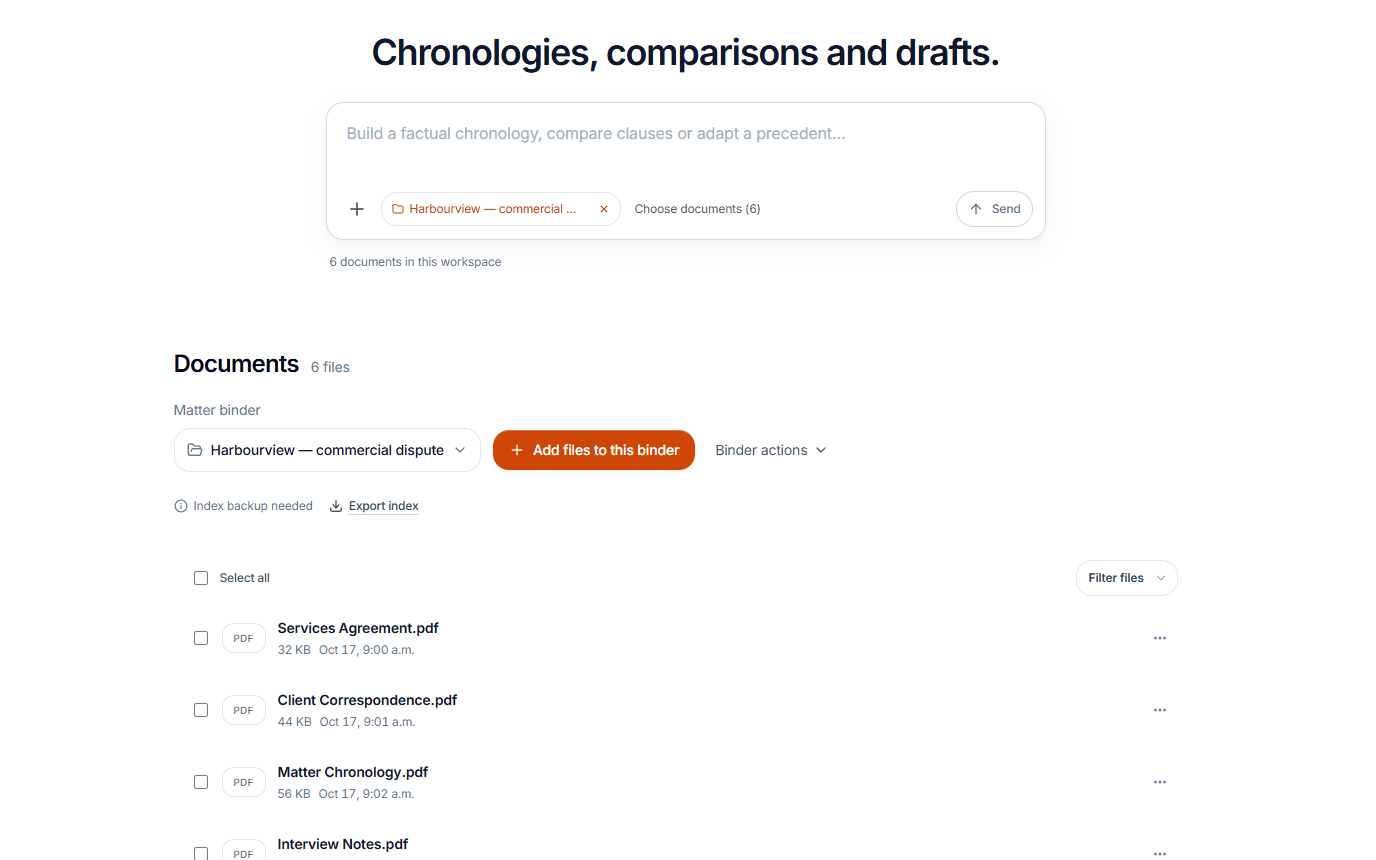
Your matter record, organized for the work ahead
Bring scanned PDFs and digital documents into searchable matter binders. Switch between matters and reuse the prepared record across linked conversations.
Canadian legal context
Canadian common law and Québec civil law, with the jurisdiction specified for your assignment.
Explore the legal librarySources within reach
Review material facts against the referenced documents and passages in your matter record.
Our review approachYour work stays yours
No AI training on your data or chats. Browser-stored binders with exportable index backups.
Security and privacyWork counsel can use
Less document grunt work. More command of the matter.
Choose the assignment. Keep the evidence, instructions and source references connected to the work.
Detailed factual chronologies
Reconstruct the matter from the record, with the detail counsel needs and references that make review practical.
- Distinguish event dates from correspondence dates.
- Set out conflicting accounts with document and page references.
- Request a detailed working chronology or a shorter issue-specific version.
Witness-specific records
Bring a witness’s relevant communications, events and exhibits together for preparation and review.
- Gather the documents relevant to each witness.
- Compare the account with contemporaneous records.
- Keep witness statements distinct from what the documents establish.
Evidence comparisons and production gaps
Trace factual assertions to supporting and contradictory material. Identify what still needs to be obtained or clarified.
- Compare each proposition with the relevant passages.
- Look for referenced attachments, amendments and unanswered correspondence.
- Prepare a follow-up list for apparent gaps in the documents provided.
Polished, coordinated precedent-based drafting
Carry matter facts and instructions into agreements, resolutions, certificates, letters and forms in the legal workspace.
- Adapt document precedents and Word/PDF templates, retaining the firm’s structure and replacing previous-client details.
- Request consistent party details, defined terms, numbering, cross-references and schedules.
- Check drafts against the term sheet, client instructions, agreed changes and details requiring confirmation.
Contract tables and due diligence
Turn scattered agreements into structured summaries for the transaction or review mandate.
- Extract parties, terms, renewals, notice provisions and required consents.
- Compare principal agreements, amendments and ancillary documents.
- Request source-referenced schedules and outstanding due-diligence questions.
Closing preparation and document review
Prepare the document lists, outstanding items and drafting checks that help counsel move the transaction forward.
- Prepare a closing agenda and compare required documents with those provided.
- Extract post-closing actions and the responsible parties identified in the record.
- Request a check of placeholders, defined terms, cross-references and inconsistent wording.
Keep the record. Carry the work forward.
- 01
Create the matter binder
Add the documents for the matter, including scanned PDFs. Give the binder a recognizable name and link relevant conversations.
- 02
Set the legal assignment
Ask for a factual chronology, clause comparison, material-issue analysis or draft. Specify the scope, jurisdiction and deliverable.
- 03
Review, refine and reuse
Check the supporting sources and refine the result. Carry the matter record into the legal workspace for drafting, template completion or Canadian legal research.
Specify the province or territory, court or tribunal and relevant instructions. The legal assignment should reflect the applicable Canadian law and procedure, including Québec civil law where relevant.
When more documents arrive
Add the new material to the binder and specify what needs updating. Provide the reviewed chronology, table or draft and your corrections as part of the next assignment, and ask for a comparison with the new record.
AI matter management, explained
What is AI matter management in TruLexa?
It brings matter-document organization, search, analysis and polished legal drafting into one workspace. Digital binders keep the record organized while you work on chronologies, material issues, contract comparisons and legal drafts.
Can I analyze scanned PDFs and large document sets?
Yes. TruLexa prepares scanned pages for search and supports large matter-document collections. The binder holds the record; each assignment determines which source material is used for analysis or drafting.
Can I reuse a binder across conversations?
Yes. Link relevant conversations to the binder and reuse the prepared matter record for later assignments. Add documents as the matter develops and retain an exported index backup.
How does this work with Canadian legal research?
Use the matter documents to frame the facts, material issues and evidence gaps. Where the assignment calls for legal authority, continue into Canadian legal research with linked citations, including deep research. A factual chronology can remain focused on the record.
Does this replace billing and practice administration?
TruLexa focuses on substantive legal work and matter documents. Continue using your firm’s systems for timekeeping, billing, trust accounting and calendar administration.